Week 1
Learning Music
This assignment was great! This course, Music Technology, may be the last college course I ever take.. and it's genuinely the most fun I've had in my education. I've never experimented with music in this way and learned a lot from this lesson! Who knew playing with some drums, bass, chords, and melodies could be so enlightening?! I've included a screenshot of my favorite combination from the first chapter.. This really got me excited for the rest of the lesson.
It was so fascinating to match terminology and explanations to sounds that are so familiar. For example, just by listening to a simple "four on the floor" with a backbeat, several popular songs rushed to the front of my mind (Dynamite by Taio Cruz was one of the first songs I thought of lol). The formation of many well known songs are actually so simple. As I experimented more with the elements, more and more songs famililar to me, both popular and niche (shoutout to So 4 More by BTS), began to get stuck in my head! It was fun to see how much variety is possible just by adding or removing certain elements, or by speeding up/slowing down the tempo. I enjoyed playing with the closed hat a lot. While the kick remains consistent and sets the pace, all of the unique possibilities seemed to really come from the placement of the closed hat.
I noticed something in my personal taste that was confirmed once I saw the comparison between a "classic rock" beat and a "house" beat. When I was playing with the closed hats, I liked when they were positioned between the kicks and claps. Now looking at the pattern for house music, the closed hat placement is similar. For both rock and house, the kick drum follows the "Four on the Floor" and the snare/clap/backbeat is on the 5th and 13th position. However, the rock pattern places closed hats with the kicks and claps, but the house pattern places that hats between. I like the sound of both. I would describe the rock pattern as more chill, kicked back, and groovy, while the house music is more tense, suspenseful, and fun.

DAW Loops
MY CREATION:
https://chrome.soundation.com/project/6e0c4557-f420-4046-9a09-ee35db7fa4e1
REFLECTION
After listening to many loops within Soundation, the first step to my creation was choosing a drum loop. One limation I faced was that many of the sounds I liked were part of the Pro version, and I wanted to stick with the free samples. At first I was overwhelmed by all of the different genres. I liked some of the acoustic drums, which sounded like hip hop. However, I found that the electronic drums were better for mixing with the other elements that I liked, such as the synth keys and bells. I ended up going with “Trap Beat” for the drums, which has 70 bpm. I was mindful of the bpm while looking for a bass loop that matched and chose “808 base slide”. The goal from this point forward was to chose loops that seemed similar in genre and tempo.
For the next step of my creation, I looked for bells, keys, and choir loops. It was difficult to find bells and keys that sound good together. Both were very strong elements, serving as the main melody component, so many of the combinations felt like they were overpowering each other and didn’t sound appealing. After testing a few different combinations, I finally landed on something that clicked.
When creating the structure of the song, I was rearranging the position of the loops. While moving my synth keys, I realized “Orange Hood Piano” was hiding in my workstation from when I was originally testing loop combinations. Instead of deleting it, I worked to see if there was a place for it anywhere in my groove. I realized it had a very similar melody to the synths. I thought the piano sounded good as an intro melody with the bell, before adding the synths with the electronic drums to pick up the beat. I tried to arrange the loops in a way that built pressure and anticipation. I pretty much just used common sense as a listener of music, thinking about how songs tend to fade in and fade out. I started with bass, keys, and bells, then added drums and choir where I wanted the song to pick up. Then, to make things more interesting, I experimented by putting gaps in the measures before picking up the beat again.
Overall, it was easy to have a sense that certain loops didn’t go well together, but it was difficult to find combinations that felt right. I would really enjoy having full access to these loops so I can play with more combinations of sound. I also struggled with finding the right placement of the loops, but I think I have a good start!
Week 3
Learning Synths
3 Intriguing Things About Synths.
-
I had fun learning about the controls of synths. One thing I liked learning about was brightness. I tend to enjoy synth sounds with a lower brightness. The movement control was also fun. A control that adds a bit of a pulse to the music is quite useful.
-
Learning about the envelopes of a synth was super fascinating! I can see how this is a great way for musicians to easily control the pitch over a period of time. As I played with the envelop shapes more, I started to recognize the sounds as similar to things I have heard in music before. I enjoy seeing the visuals for attack, decay, sustain and release.
-
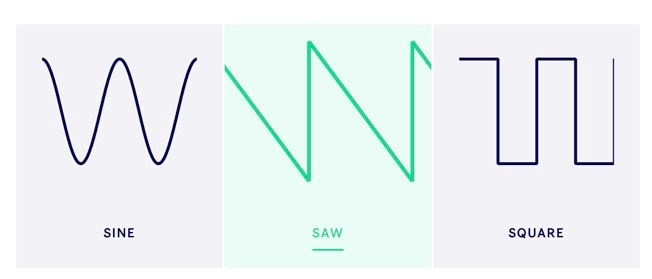
The modulation shape is also another intriguing element of this technology. Seeing the difference between sine, saw, and square was fun. I really like how the saw wave sounds. Overall, this website had amazing visualizers and interactions to learn how synths are made!


Week 2


3 Track MIDI Composition
Trying to create a piece of music in Acid Machine was quite overstimulating! After playing around with sound combinations and researching chord progressions for hours, I struggled t create anything that sounds like music. I still do not understand the synth patterns of this DAW. After reading the articles and watching youtube videos, the Acid Machine website remains mysterious to me. I tried creating synths, but they don't sound right. The one part of my music piece that I actually liked was the drum pattern I created. However, as I’m typing this, I went back to the website to revisit my pattern to see that I accidentally deleted it! Silly me!
I am not a musician. I do not know music theory. I am not skilled with computer technology. I’ve apparently forgotten how chords work? Oh well! I am simply a student taking a music class an an elective, and wow!… this lesson stumped me. I give credit to all of the creative, intelligent, and hard-working musicians out there. I have been humbled. I still tried my best using this free resource. I wonder how different my experience would have been if I was working with a premium DAW.
After hours of experimentation and somehow deleting my progress, I have started from scratch and created a new drum pattern. I’ve also created some very unpleasant synth patterns. I am somewhat satisfied with Synth number 2, which serves as a funky melody, but I still can’t really understand how to make Synth 1 sound like nice, chill, little chords. I also noticed at the end of my work, that I was working in 130 bpm the whole time. No wonder I was so overstimulated! I changed it to 100 bpm, and think this helped a bit. I’ve screen recorded my work and uploaded it to youtube, so that a link can be shared. At least I was able to learn about MIDI and synthesizer controls along the way!
Youtube Link: https://youtu.be/npodR2pSHvo
Week 4
Recording Assignment
I could have made a very long list of things that went wrong during this process. The first issue is that I do not have access to a decent DAW or a microphone or any music equipment. The second challenge I faced was that there aren’t many MixPad tutorials, and the ones I did find seem to be outdated. In general, I find that this DAW was not intuitive and difficult to use. Just when I thought I had figured out the most simple functions, random things would happen that made no sense to me. For example, when I attempted to make my own MIDI chord progressions, the second chord in the set was the only one that played back in staccato, while the other chords carried out in legato (I had to look up those terms, so hopefully I’m using them right.) Another obstacle I stumbled into was when I attempted to create a beat. I used the “Create Beats” function within MixPad, saved the file, then tried importing, and it said this file was not compatible with MixPad… beats me! … :’) I eventually figured out how to add it.. kind of. I also couldn't trim audio so this was another one of many many challenges that limited my creation.
I decided to use the mysterious, mind-of-its-own chord progression as my main MIDI track. After listening to various sound options, I chose the Synth 1 channel. The next part of my creative process was a fun experiment. After failing to create a beat electronically, and being brought to tears by a piece of technology, I had the idea to use the built-in microphone and record an acoustic beat using the sounds of my very own sniffling! It reminds me of a closed hi-hat. Then, to add some vocals, I recorded myself reciting the instructions of the week 4 recording assignment.
Overall this experience was like being lost in the desert. After 5 hours I had lost all hope and sanity. It was honestly frustrating because I believe I have a creative mind and a good ear… but I am severely limited in my patience and understanding of technological programs. So sad! This would have been a great class to take with in-person instruction and guidance!
My recording: https://youtu.be/CjLArhdBqQo